
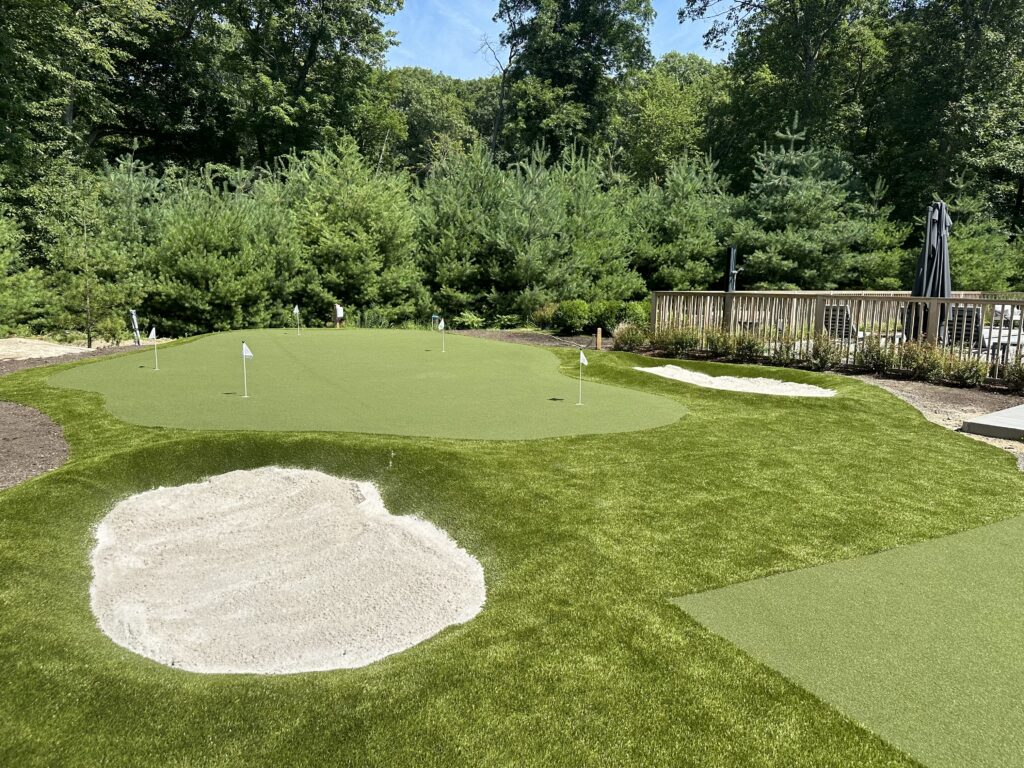
A backyard putting green can turn an unused part of your yard into a dedicated space for putting and short-game practice. But how much does a backyard putting green cost?
Artificial turf installations typically range from $10 to $15 per square foot, while putting greens generally cost more because they require additional grading, base preparation, shaping, cup installation, and finishing.
The final cost of a backyard putting green depends on its size, the condition of the property, backyard access, turf selection, drainage requirements, and the level of customization.
Why Backyard Putting Greens Cost More Than Standard Artificial Grass
A regular artificial lawn is designed to provide a durable, attractive surface. A putting green has to do more.
The surface needs to produce a consistent ball roll, and the base underneath it often needs to be shaped carefully to create breaks and contours. Cups have to be positioned correctly, seams need to be placed carefully, and fringe or chipping areas may require additional turf products.
All of those details make putting green installation more labor-intensive than your average landscape turf project.
Based on ForeverLawn CTNY’s experience installing putting greens throughout Connecticut and New York, these projects typically require more precision and installation time than standard artificial turf lawns.
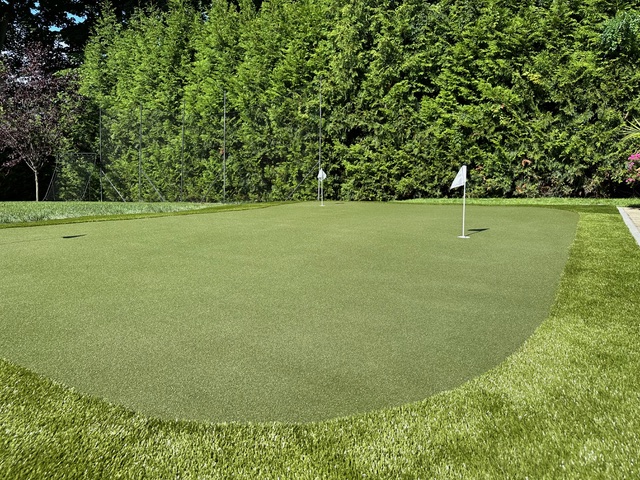
What Affects the Cost of a Backyard Putting Green? 10 Factors
Two putting greens with similar square footage can have very different prices. Much of the difference comes down to the property, the design, and the work required before the turf goes down.
1. Size of the Putting Green
The bigger the putting green, the greater the quantity of grass, materials, and labor needed for the job.
But just because the putting green is small, that does not mean that its cost per square foot will be much less. It will still take some equipment, materials transport, site preparation, grading, cutting, and finishing.
A smaller putting green with one or two holes offers enough practice area nonetheless.
2. Site Preparation
A large part of a putting green installation happens below the surface.
Before the turf goes down, existing grass, soil, roots, and other material may need to be removed. The area then needs a properly prepared and compacted base.
Some properties are fairly straightforward. Others may have:
- – Uneven ground
- – Poor drainage
- – Large roots or rocks
- – Soft or unstable soil
- – Existing hardscape
- – Significant changes in grade
The more preparation the site requires, the more labor and material will be involved.
3. Type of Turf
The turf product itself also affects the price.
Artificial grass comes in different materials and constructions. Turf designed for a residential lawn is different from turf made specifically for putting. Material choice can also affect pricing since nylon and polyethylene turf have different characteristics and costs.
ForeverLawn CTNY uses GolfGreens products for backyard putting greens. These surfaces are made for putting and short-game practice, with options for different speeds, fringe, contours, and layouts. Your green can be designed as a compact practice area with one or two cups or as a larger setup with multiple putting lines.
For a putting green, the turf should be chosen based on how you want the surface to play, not simply how it looks.
4. Access to the Backyard
Access is one of the easiest pricing factors to overlook.
If equipment and materials can be brought directly into the backyard, the installation may be relatively straightforward. If everything needs to be carried through a narrow gate, around landscaping, down a slope, or up a set of stairs, more work may need to be completed by hand.
That additional labor can affect the final quote.
Access can be especially important on properties throughout Fairfield County and Westchester County, where mature landscaping, stone walls, fences, slopes, and tighter entrances are common.
5. Shape of the Green
Putting greens do not have to be simple circles or rectangles. Many are shaped to follow the layout of the yard.
Curves and irregular shapes can give the green a more natural appearance, but they may also require additional cutting and fitting.
Artificial turf comes in rolls and has a directional grain. Pieces need to face the same direction so the finished surface looks consistent and performs properly.
More complicated shapes can also create additional material waste, which may affect the amount of turf needed for the project.
6. Contours and Breaks
A completely flat green may be simpler to build, but adding subtle breaks gives you more variety when you practice.
Contours are created by shaping the base beneath the turf. More involved breaks require additional time and precision during installation.
You do not necessarily need dramatic slopes. Even a few subtle contours can make a smaller putting green much more interesting to use.
7. Number of Cups
Cup placement is another part of the design.
A compact putting green may only need one or two cups, while a larger design can include several. Multiple cups give you more putting lines and allow you to practice from different directions.
The number of cups usually will not be the largest cost factor, but it does add to the design and installation work.
8. Fringe and Chipping Areas
Fringe can give a backyard putting green a more complete appearance while also adding another area for short-game practice.
Some homeowners want a simple fringe border around the putting surface. Others want a larger surrounding area where they can practice chips and approach shots.
Adding fringe requires more turf and additional cutting and fitting, so it can increase the overall project cost.
9. Drainage and Grading
Drainage is an important part of any artificial grass installation, including a putting green.
If the space already has standing water, drainage issues, or bad grading, then those may have to be fixed before the installation of the putting surface.
The base needs to allow water to move away from the surface while providing a stable foundation for the green.
10. Other Backyard Features
A putting green is one feature of a larger backyard renovation project.
Some homeowners want the putting green worked into an existing patio, pool area, seating space, or landscape design.
Other features may include:
- – Stone or paver borders
- – Pathways
- – Planting beds
- – Retaining walls
- – Landscape lighting
- – Seating areas
- – Steps
- – Transitions between turf and hardscape
Adding these features can change the overall project budget.
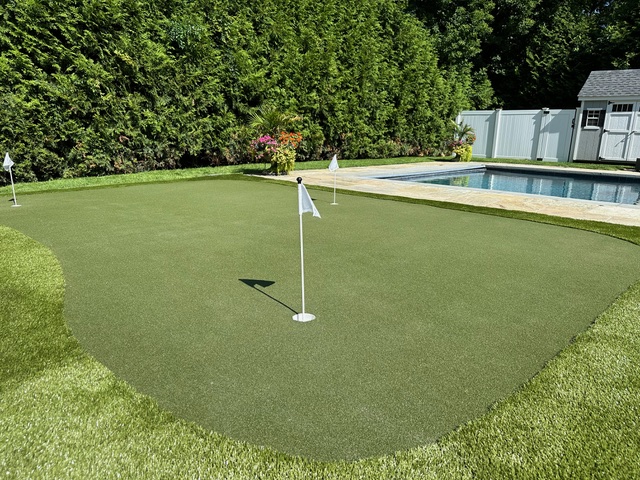
Does a Small Backyard Putting Green Cost Less?
Usually, but not always by as much as you might expect.
For a smaller putting green, you need less turf and less base, which helps keep the costs down. But still, the work needed for installation is quite similar to that of a bigger installation.
The process involves preparing the site, digging where necessary, laying the base, shaping the green, installing the cups, laying the turf, and finishing the borders.
That is why a compact putting green can sometimes have a higher cost per square foot than a larger, simpler installation.
How Much Should You Budget for a Backyard Putting Green?
The most useful way to think about putting green pricing is to start with the broader artificial turf range and then account for the additional work involved.
ForeverLawn CTNY generally sees artificial turf installations around the $10 to $15 per square foot range, but putting greens are typically more expensive because they are more detailed and time-consuming to build.
A basic putting green on an open, easy-to-access property will usually be less expensive than a highly customized green with multiple contours, several cups, fringe, difficult access, and extensive site preparation.
Rather than relying on a generic online calculator, the best way to price a putting green is to look at the actual property.
Can You Save Money With a Simpler Putting Green Design?
Yes. You do not need every possible feature to create a putting green that is enjoyable to use.
If you are working within a particular budget, you can keep the design simpler by:
- – choosing a smaller footprint
- – using one or two cups
- – keeping contours subtle
- – using a simpler overall shape
- – limiting the amount of fringe
- – choosing an area with easier access
- – avoiding unnecessary changes to existing hardscape
A good compact design will provide you with multiple angles to put from.
Artificial vs. Natural Backyard Putting Greens
Natural putting greens can look great, but keeping them in playable condition requires considerably more maintenance.
Grass needs to be cut extremely short and maintained consistently. Watering, fertilizing, weed control, aeration, pest management, and repairs may all become part of the routine.
Artificial putting greens have a higher upfront installation cost, but they require much less ongoing work.
Leaves and debris still need to be removed, and the surface may occasionally need brushing or rinsing, but there is no mowing, fertilizing, or reseeding.
For homeowners who want a putting surface they can use without maintaining golf-course-style grass, artificial turf can be a more practical option.
Can You Install a Backyard Putting Green Yourself?
A small DIY green may look straightforward at first, but much of the work happens underneath the turf.
A putting green installation may involve:
- – excavation
- – material removal
- – grading
- – base installation
- – compaction
- – contour shaping
- – cup placement
- – turf cutting
- – seams
- – fringe installation
- – surface finishing
Problems with the base can affect drainage and ball roll, while poor seam placement or shaping can become noticeable once the green is finished.
Professional installation gives you a surface built around the property and the way you plan to use it.
How to Get an Accurate Backyard Putting Green Quote
Square footage is only the starting point.
A useful quote should also take into account:
- – the condition of the existing yard
- – the amount of excavation required
- – drainage
- – grade
- – backyard access
- – turf selection
- – green shape
- – contours
- – cup placement
- – fringe
- – surrounding landscape features
ForeverLawn CTNY evaluates these factors during the site visit before putting together a quote.
Get a Backyard Putting Green Quote in CT or NY
There is no one-size-fits-all price for a backyard putting green. A compact practice green with one cup is a very different project from a larger short-game area with multiple cups, breaks, fringe, and custom shaping.
ForeverLawn CTNY designs and installs GolfGreens throughout Fairfield County, Connecticut, and Westchester County, New York. We can create a small putting green for an unused corner of the yard, a narrow practice lane, or a larger setup with more putting and chipping options.
Contact us today to schedule a consultation. We will visit the property, look at the space, discuss how you want to use the green, and provide a quote based on the actual project.